- Licensed & insuredCertificates provided to every client
- Open 24/7Emergency calls, no night or weekend fee
- 2-year labor warrantyOn new roofs, plus manufacturer warranty
- Free written estimatesPhotos of every problem we find
Key facts
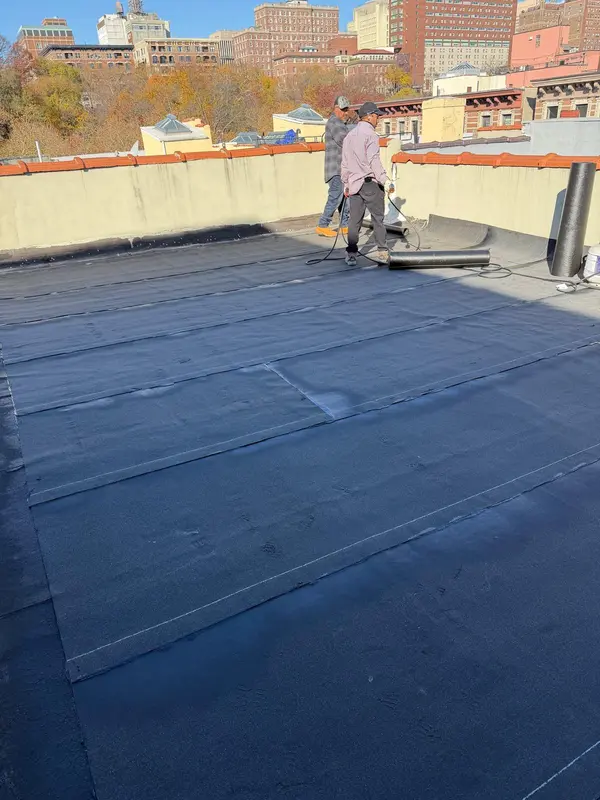
- Systems: TPO, EPDM (rubber) and modified bitumen (torch-down, cold-applied or self-adhered).
- Services: new flat roofs, flat roof replacement, flat roof repair, recover where allowed, coatings.
- Warranty: 2-year labor warranty on new flat roofs plus the manufacturer's material warranty; 3-year warranty on silicone coatings.
- The keys to a long life: slope to drains, properly bonded seams and flashing carried up and over walls and curbs.
TPO vs EPDM vs modified bitumen
| TPO | EPDM (rubber) | Modified bitumen | |
|---|---|---|---|
| What it is | Thermoplastic single-ply sheet, usually white | Synthetic rubber sheet, usually black | Asphalt reinforced with polymer, in two or more plies |
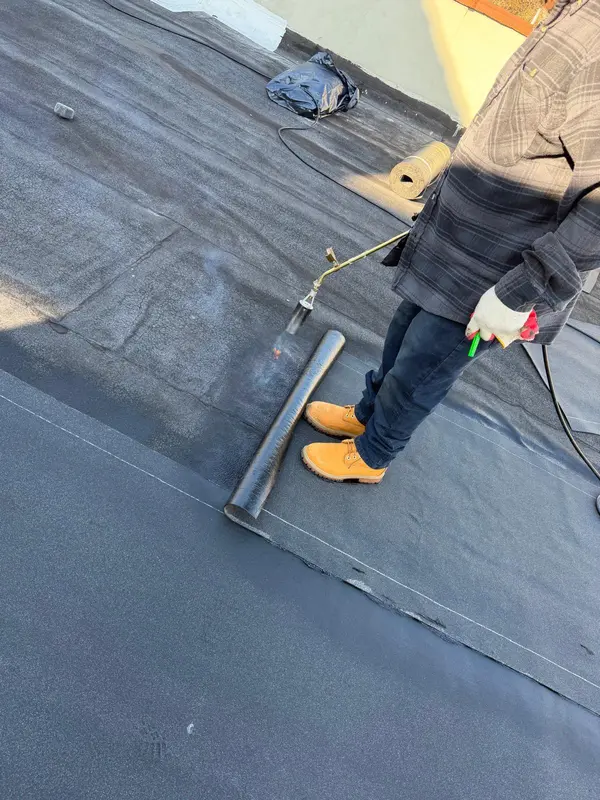
| Seams | Heat-welded | Taped or glued | Torched, heat-welded or self-adhered laps |
| Best at | Reflecting summer heat; large roofs | Cold flexibility; big, simple roof areas | Foot traffic, punctures, busy roofs with many details |
| Typical published life | 20–30 years | 20–30 years | 15–25 years |
| Common on | Commercial and some residential | Homes and commercial | Homes, row stores, multifamily |
| Watch-outs | Welding quality; product varies by manufacturer | Seam tape and flashings age first | Fire safety with torch; seams must be fully bonded |
Flat roofs on houses
On a typical Nassau County home, the flat roof is the rear kitchen extension, a shed dormer added to a Cape, a porch, a sunroom or the garage. These small roofs leak far more often than their size suggests, because almost all of their area is edges and transitions: where the flat roof meets the main shingle roof, the wall of the second story, a skylight or a vent. We pay particular attention to:
- The tie-in to the shingle roof, where membrane must run up under the shingles far enough that water cannot back up over it.
- Wall flashing run up behind siding, with counterflashing, rather than glued to the face of it.
- Edge metal and gutters that actually carry water off the roof.
- Slope: many old extensions were framed dead flat. A tapered layer can fix ponding without rebuilding the roof.
How we install a new flat roof
Tear-off and deck repair
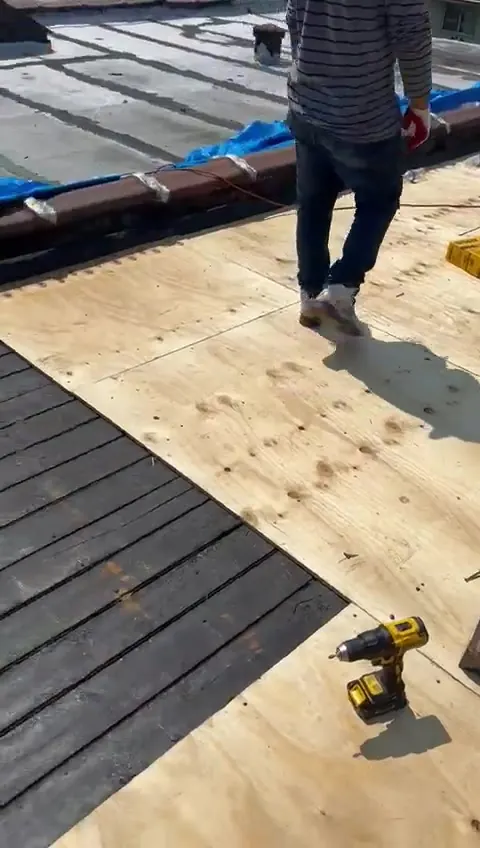
Old layers removed, rotted plank or plywood replaced, new plywood laid over old plank decks where needed.
Insulation and slope
Rigid insulation fastened down, tapered where the roof needs drainage, cover board where the system calls for it.
Membrane
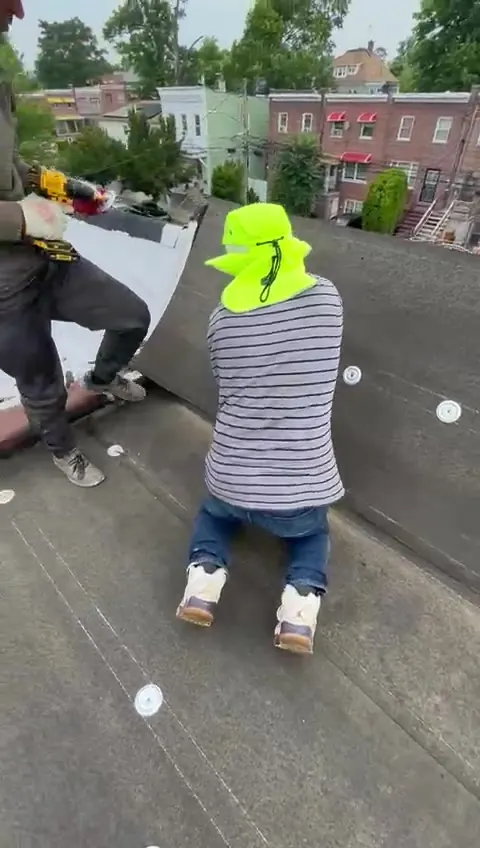
Base and cap sheets for modified bitumen, or TPO and EPDM sheets, with seams lapped and bonded to the manufacturer's spec.
Flashing
Turned up and over parapets and walls, around curbs, skylights, drains and pipes, then counterflashed.
Finish
Reflective coating on modified bitumen where wanted, edge metal, drains and a final water check.
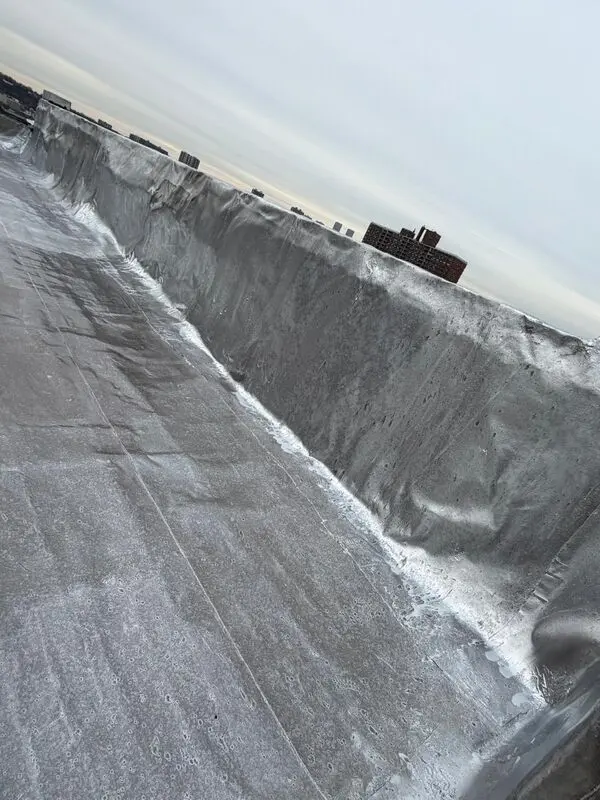
Flat roof repair
A flat roof with years of life left can usually be repaired: an open lap re-bonded, a blister cut out and patched, a parapet re-flashed, a drain reset. The tell-tale signs that repair is no longer enough are seams open along their full length, many generations of tar patches, soft spots underfoot that mean wet insulation, and ponding over large areas. See roof repair for how we trace leaks, or emergency roof repair if water is coming in now.
Commercial flat roofs
On stores, offices, warehouses and apartment buildings, the same membranes are used at a larger scale, with mechanically fastened or fully adhered insulation and code-required R-values. See commercial roofing and commercial roof replacement for how those projects are planned.
We work across all of Nassau County: the Towns of Hempstead, North Hempstead and Oyster Bay and the Cities of Glen Cove and Long Beach. See our service areas or read how we work.
Frequently asked questions
Which is better for a flat roof: TPO, EPDM or modified bitumen?
None is best everywhere. TPO suits roofs where a white, reflective surface helps with summer heat and seams can be heat-welded. EPDM suits large, simple roofs and handles cold well. Modified bitumen is the toughest under foot traffic and the easiest to detail around lots of pipes, curbs and parapets. On homes, modified bitumen and EPDM are the most common; on commercial roofs, TPO is widely used.
Is it normal for water to sit on a flat roof?
A little water that is gone within a day or two after rain is normal. Water that sits longer is called ponding and it is a problem: it speeds up aging of the membrane, adds weight and finds any open seam. The fix is better slope, usually tapered insulation or crickets, and clear drains.
Is torch-down roofing safe on a house?
Torch-applied modified bitumen is common and safe in experienced hands with proper fire-safety practice, including a fire watch after torching. Near wood siding, eaves and other combustibles, self-adhered or cold-applied modified bitumen avoids open flame at those details. We choose the method detail by detail.
How long does a flat roof last on Long Island?
Typical published ranges are about 15 to 25 years for modified bitumen and 20 to 30 years for EPDM and TPO, with the real number depending on installation, drainage, sun exposure and maintenance. Flat roofs with good slope to drains and flashing that is inspected regularly reach the upper end.